

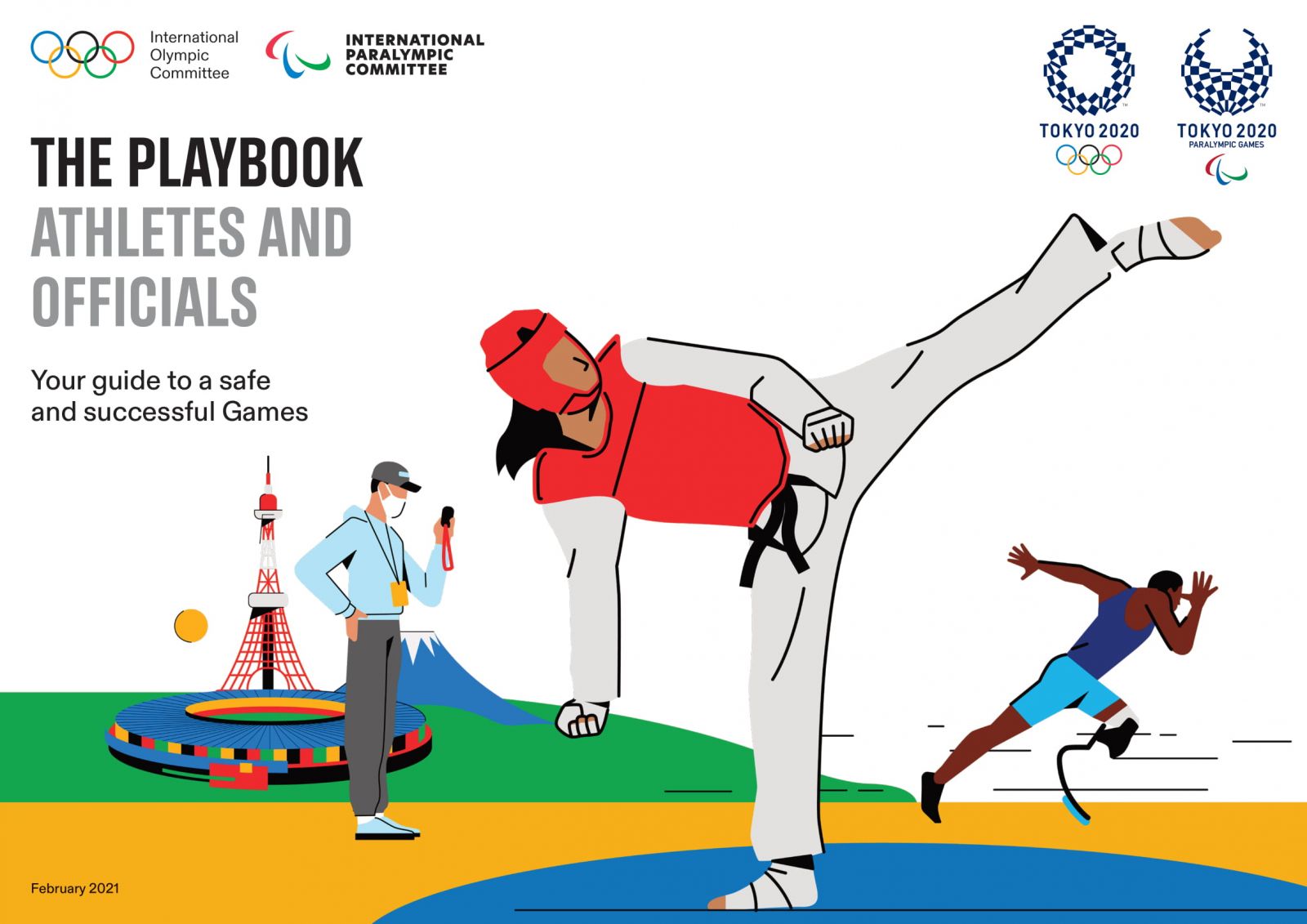
EXTRACT FROM THE PLAYBOOK FOR ATHLETES AND MEMBERS OF THE DELEGATION, DEVELOPED BY THE IOC, IPC AND THE TOKYO 2020 ORGANIZING COMMITTEE IN FEBRUARY 2021.
COVID-19 SECURITY MEASURES
(excerpt from the Playbook for athletes and delegation Members developed by the IOC, IPC and the Tokyo 2020 Organizing Committee in February 2021.)
COVID-19 COORDINATOR
The NOC and NPC are invited to appoint a COVID-19 Coordinator (a COVID-19 Liaison Officer), a key figure on COVID-19-related issues and a contact point for the IOC/ IPC, the Tokyo 2020 Organizing Committee, and the Japanese health authorities. The COVID-19 Coordinator is called upon to monitor strict compliance with the rules outlined in the Playbook.
Responsibilities of the COVID-19 Coordinator:
Advises participants in advance and during the Games on issues related to COVID-19;
Has access to reports on the health status of the participants of the Games in accordance with the laws and regulations concerning the protection of personal information (p. 13)
In case of a positive test for COVID-19 within 14 days prior to departure to Japan, upon arrival and during the Games, records symptoms, close contacts and the results of repeated tests, as well as informs the organizers and agrees on further steps regarding the isolation of the participant and the further course of the Games, for example, the need to disinfect certain rooms (p. 14, 22);
If a participant of the Games has symptoms of COVID-19 within 14 days before departure to Japan, upon arrival and during the Games, inform the organizers and agree on further steps (p. 14, 18);
Receives and confirms in advance the lists of persons with whom the participant of the Games plans to have close contact. The lists provided can then be used to track contacts (p. 15);
May call Game participants for testing if they come into contact with a person who has tested positive for COVID-19 (p. 23).
No later than April 2021, the updated Playbook will publish details on the duties of the COVID-19 coordinator and on the definition of "close contacts".
VACCINATION
The IOC has sent letters to the NOC asking them to actively engage with their Governments on the issue of vaccination and to inform the IOC of the situation in early February 2021. The NOC is encouraged to work in this direction together with the relevant NPCs.
However, vaccination is not required to participate in the Games. The rules set out in the Playbook must be followed regardless of the fact of vaccination.
PERSONAL HYGIENE AND SOCIAL DISTANCING
It is necessary
to: minimize physical interaction with other persons, avoid physical contact, including hugs and handshakes;
keep a distance of 2 meters from athletes and at least 1 meter from other people;
avoid enclosed spaces and crowds if possible;
to use transport intended specifically for Games, not to use public transport without having a permit to do so;
leave the Olympic/A Paralympic village (or other designated place of residence) is only allowed with the goals set out in the individual 14-day plan;
if possible, avoid exchanging things, always disinfect items that were previously used by someone else.;
wash your hands regularly and thoroughly for at least 30 seconds, if possible with warm water and soap, otherwise with hand sanitizer;
wash your hands and disinfect surfaces before eating, which should be assisted if necessary.
avoid shouting, singing, etc., show support to athletes and celebrate the victory in other ways (for example, with applause);
ventilate public areas for a few minutes at least every 30 minutes.
The restriction to keep at least two meters away from others does not apply to people who need additional support, who can get help from their immediate environment.
When helping others, you should always wear a mask;
After providing assistance, it is necessary to disinfect the hands and return to distancing.
You can temporarily remove the mask if you are talking to or helping someone who relies on lip reading, clear sound, and/or facial expressions to communicate. At the same time, you should stay at least two meters away and put the mask back on as soon as possible.
If you are using a wheelchair or other means of transportation that can be handled by another person under certain circumstances (for example, an accompanying person), regularly treat the relevant surfaces with disinfectant wipes.
WEARING MASKS
Necessary:
Make sure that there are enough masks for each member of the delegation for the entire duration of their stay in Japan;
when using fabric masks, make sure that they can be washed regularly at high temperatures (60°C or more-WHO) and that they consist of 2-3 layers:
- the outer layer of an absorbent material, for example, cotton;
- the middle layer of non-woven material, for example, polypropylene;
- the outer layer is made of a non-absorbent material, for example, polyester or polyester blend;
if possible, wear a mask at all times, except for sleeping, eating, and when you are outside buildings and two meters away from others;
disinfect your hands before putting on the mask, avoid touching your eyes, nose and mouth;
cough only in a mask, sleeve or napkin;
replace the mask as soon as it becomes wet (in hot and humid weather, you should use more masks than usual);
wash reusable masks daily;
dispose of used wipes/disposable masks/filters, preferably in a resealable waste container.
WHO recommendations ("Use of masks in the context of COVID-19", 05.06.2020):
https://apps.who.int/iris/bitstream/handle/10665/332293/WHO-2019-nCov-IPC_Masks-2020.4-rus.pdf
masks should be used strictly individually;
before putting on the mask, it is necessary to perform a hygienic treatment of the hands;
it is necessary to check the mask for tears or damage;
the mask must be worn carefully, so that it covers the mouth and nose, after which it is necessary to bend it in the shape of the nose and tighten it, minimizing the gaps between the face and the mask;
do not touch the mask on your face;
remove the mask using the proper technique, that is, by holding the elastic bands from behind, without touching the front of the mask;
hold the mask after removing it so that it does not come into contact with surfaces;
after removing the mask or if you accidentally touch the used mask, treat your hands with an alcohol-containing product or (if there are visible impurities) wash them with soap and water;
as soon as the mask becomes wet, replace it with a new one, clean and dry;
do not reuse disposable masks;
if the reusable mask is dry and clean and you intend to reuse it, put it in a clean, resealable plastic bag;
when removing the mask from the bag, hold it by the ties or ear loops;
Fabric masks are recommended to be washed with soap or detergent in hot water (60°C or more) at least once a day.
The face shield / visor is not an acceptable alternative to the mask. They should only be used to prevent infection of the eye area or in situations where wearing a mask is impractical.
WHO recommendations: When using face shields, it is necessary to choose models that cover the face at the edges and below the chin. In addition, these products may be more comfortable to wear by people who, for health reasons, are not suitable for a medical mask.
BASIC RULES
BEFORE THE TRIP
Your trip starts 14 days before you leave for Japan;
Make a plan of action for the first 14 days of your stay in Japan;
Download and install the COCOA smartphone app and sign up for it;
Monitor your health daily for 14 days before traveling to Japan;
Prepare and send your COVID-19 coordinator a list of all the people you plan to have close contact with during your stay in Japan;
Take a Japanese government-approved COVID-19 test within 72 hours before your flight.
ENTRY TO JAPAN
Present all necessary documents and proof of a negative COVID-19 test taken within 72 hours prior to the flight;
Be prepared to re-take the COVID-19 test at the entrance (at the airport, or at the Olympic/The Paralympic village, or at the site of a training event);
Move around the airport as quickly as possible;
Use special corridors for the participants of the Games, which will be shown to you by airport officials, to minimize contact with unauthorized persons.
AT THE GAMES
Participants will be screened (if necessary) and tested for COVID-19 at various intervals (at least every 4 days) throughout the trip;
The time and frequency of testing can be adjusted depending on your sport and competition schedule.;
Testing will be conducted at a special facility in the Olympic/In the Paralympic Village or in specially designated areas for athletes living in other places;
In the case of living in informal housing - to pass the test, you must come to the Olympic/The Paralympic Village;
You should pass the test immediately after receiving the appropriate notification;
The test results will be processed and interpreted in a timely manner, taking into account individual health characteristics.;
You are responsible for continuously monitoring your personal health and reporting on it daily through the health report app;
Be prepared that your temperature will be measured every time you enter the facility.:
- If a temperature of 37.5 degrees or higher is recorded, an additional measurement will be performed to confirm;
- If the temperature is again recorded at 37.5 degrees or higher, you will not be allowed to enter the facility. You will be placed in isolation, where you will wait for further measures;
- If you are already in the venue of the Games, you will be taken to the medical center for a health check;
If you suspect COVID-19, you will be taken to an outpatient clinic in Olimpiyskaya/A Paralympic village or other medical facility to test for COVID-19;
You should immediately take a test and isolate yourself if you experience any symptoms of COVID-19* or if you are notified by contact tracking services.;
If you test positive for COVID-19, you will either have to maintain isolation or be hospitalized; you will not be able to continue participating in competitions;
The location and duration of the isolation period will be determined by the Japanese health authorities depending on the severity of the infection;
You will be released from the isolation ward in accordance with the rules of discharge in Japan.
DEPARTURE FROM JAPAN
Be prepared to take a COVID-19 test before leaving;
Keep up to date with the latest entry requirements to the Russian Federation, as well as (if necessary) to transit countries.
SYMPTOMS OF COVID-19 ACCORDING TO WHO:
The most common symptoms are an
increase in body temperature;
dry cough;
fatigue and weakness.
Less common symptoms:
muscle and joint pain;
sore throat;
diarrhea;
conjunctivitis;
headache;
loss of taste or sense of smell;
skin rash or discoloration of the skin on the fingers or toes.
Severe symptoms:
shortness of breath or shortness of breath;
pain or feeling of tightness in the chest;
violation of speech or motor functions.
MEDICAL INSURANCE
You will need to have health and repatriation insurance covering the entire period of your stay in Japan.
For athletes and delegation officials, the Tokyo 2020 Organizing Committee will provide such insurance, but only for the period between the opening date of the Village and the closing date. Please note that this insurance only covers expenses incurred in Japan.
Specific rules may apply to specific types of sports, specific venues and events, which will be developed and distributed by the organizers of Tokyo 2020, the IOC/IPC and the IF.
PENALTIES FOR NON-COMPLIANCE WITH THE RULES
Failure to comply with the rules set out above may result in consequences that may affect your participation in the Paralympic Games, your access to the Games facilities and, in some cases, your participation in competitions. Repeated or serious non-compliance with these rules may result in the loss of your accreditation and eligibility to participate in the Olympic and Paralympic Games.
Please keep in mind that some of the measures described regarding entry and exit from Japan are under the jurisdiction of the Japanese authorities. If you violate these measures, you may face consequences, such as a 14-day quarantine or a procedure for revoking your permit to stay in Japan.